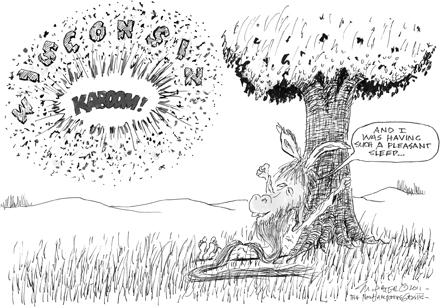
The Fortnightly Rant for March 25, 2011, from The New Hampshire Gazette, Volume 255, No. 13, posted on Tuesday, April 15, 2011.
For many a fortnight now we have used this space to report on the unrelenting efforts of the rich and powerful to gain control over those small scraps of money and influence that have as yet eluded their grasp. We have taken that approach for a couple of reasons: there is never a shortage of material because they are always up to something, and you cannot cover the defensive side of a Class War unless someone is fighting back. Now that neo-feudalism looms on the horizon, we’re pleased to announce that we’re able to devote some space to the Resistance.
The Sanders Approach
On March 10th, Sen. Bernie Sanders (I-VT) introduced an Emergency Deficit Reduction Act, “creating a surtax on high income individuals and eliminating big oil and gas company tax loopholes.”
Sadly, this bill is about as likely to pass as we are to get a Pulitzer. In its text, though, it poses some questions that need to be raised:
“Do we ask the highest paid executives on Wall Street to give up a $1 million a year tax break, or do we ask senior citizens to go cold in the winter by cutting the Low Income Home Energy Assistance Program?
“Do we ask Exxon Mobil and other big oil companies to give up their tax breaks, or do we ask over 9 million college students to go further into debt by cutting Pell Grants by $5.7 billion?
“Do we stop cutting taxes for the richest 400 American families, who earned an average of $345 million in 2007, or do we delay Social Security benefits to 500,000 Americans by a $1.7 billion cut in the Social Security Administration?
“Do we establish an emergency deficit reduction surtax on millionaires and billionaires, or do we deny over 200,000 little children the opportunity to enroll in Head Start by cutting this program by $1.1 billion?
“Do we finally tax hedge fund managers who make at least $1 billion at a higher rate than police officers, teachers, firefighters, and nurses, or will 11 million Americans be denied access to quality primary healthcare by a $1.3 billion cut in community health centers?”
The Schakowsky Bill
On March 16th, Rep. Jan Schakowsky (D-IL) introduced a similar measure. Schakowsky notes on her website that the top tax bracket currently begins at $373,000 in income and “fails to distinguish between the ‘well off’ and billionaires — like the top 20 hedge fund managers whose average income last year was over $1 billion.”
Schakowsky’s bill would create five new brackets with progressively higher tax rates:
$1-$10M 45%
$10-20M 46%
$20-100M 47%
$100M-$1B 48%
$1B+ 49%
The bill, according to Schakowsky, would also tax capital gains and dividend income as ordinary income for those taxpayers with income over $1 million. If enacted in 2011, she says, the Fairness in Taxation Act would raise more than $78 billion.
Tax rates at those levels would, of course, cause Rush Limbaugh and Grover Norquist to howl in pain. Such rates would be just a fraction of those the wealthy managed to pay from the 1940s through the 1960s — a period many regard as a Golden Age.
On the rare occasions when the discussion wanders into the realm of higher taxes for the rich, apologists for the plutocracy start claiming that there aren’t enough of them to make a difference. Sam Pizzigati lays that myth to rest at his online magazine, Too Much:
“The congressional Joint Committee on Taxation last year projected that taxpayers making over $1 million in income this year will report, all together, over $1.1 trillion in income. Tax returns from taxpayers making between $200,000 and $1 million will total almost another $1.9 trillion.
“All these taxpayers would pay a whopping $382 billion more in taxes this year if they had to pay at the 1961 effective tax rate, the rate the rich actually faced on their tax returns 50 years ago after taking advantage of every available loophole.
“That’s nearly quadruple the $100 billion conservatives in Congress are trying to cut out of this year’s federal budget for everything from Head Start and college student aid to public broadcasting.”
The Wall Street Journal, apparently suffering from a momentary lapse in judgment, recently commissioned a poll that asked Americans if they favor higher taxes on millionaires. Eighty-one percent said “yes.”
Who’d a thunk it — a huge percentage of the public supports higher taxes on the rich. There are plenty of them, and they’re making enough money to fix the budget.
In a perfect world that would be all it took. Here in Fox Nation, it’s not going to be that easy. But the facts are on the side of fairness.
Granite State Fair Tax
New Hampshire has its own budget problem. What passes for conventional wisdom tells us the problem is that we spend too much. In truth, the problem is that our tax structure was engineered for an 18th-century economy. The Granite State Fair Tax Coalition is attempting to correct that situation. Mark Fernald, the group’s treasurer, recently sent us these eye-opening facts.
• The wealthiest people in our state pay the lowest percentage of their income in state and local taxes, while the poorest pay the highest.
• A study in 2001 found that 12% of the households in New Hampshire accounted for one-half of all income, but paid far less than one-half of all state and local taxes.
• Nearly two-thirds of all state and local taxes raised in New Hampshire are property taxes.
• Our second-largest source of revenue — business taxes — is one-sixth the size of the property tax.
• Alcohol and gambling are but minor contributors to our tax stream.
• New Hampshire relies on property taxes more than any other state.
• New Hampshire has the third-highest property taxes in the nation.
Just like Congress, Concord is acting as if cutting spending on infrastructure and services is the only way possible to deal with a deficit. That’s not true.
“The Granite State Fair Tax Coalition,” according to Fernald, “is the only organization in New Hampshire that is working for property tax relief and fundamental tax reform based on the principle of fairness. Detailed analysis has shown that tax reform would allow New Hampshire to meet its obligations while cutting the tax burden on those least able to pay. The Coalition believes that the people of New Hampshire would support change if they knew the truth about taxes in our state, rather than the myths perpetuated by some politicians and media outlets.” For more see: nhfairtax.org.
U.S. Uncut
All of these proposals share one weakness: to work they will have to succeed in a political system almost entirely co-opted by an unelected plutocracy.
U.S. Uncut is different. Modeled after UK Uncut, it is a grassroots movement aiming to “make corporate tax dodgers pay their fair share.” It’s been described as a Tea Party movement that aims its ire not at the victims of our alleged economic crisis but at its perpetrators. And rather than meekly petitioning for redress through the political system, it confronts them directly.
Using social media — Facebook and Twitter — to publicize a schedule, Uncut encourage local chapters to direct protests at the local branches of tax dodgers like Bank of America, Verizon, and FedEx, then post reports and pictures online. A Portsmouth branch has already formed. It’s on Facebook at U.S. Uncut Portsmouth, and intends to hold its first action on April 15th.
Move to Amend
Finally — for now — Move to Amend proposes a Constitutional Amendment which would neuter the Supreme Court’s pro-plutocracy Citizens United decision. A draft being circulated would declare that the rights, responsibilities, and privileges of citizens of the United States are “exclusively reserved for human beings” — a vital step in the right direction.