by W.D. Ehrhart
As those of you who read my writing know, I have had for nearly three years a wonderful, though at times heartbreaking, correspondence with Rawand Gawad abu Ghanem, a young Palestinian woman living in Gaza with her husband and two sons, Yamen, six, and Mohammed, one and a half. I’ve written about her before.
I’ve just received another letter from her dated October 21st, but I only received it a few days ago. She writes:
My Dear Friend,
I am sorry to write to you of new sorrow, but sometimes just holding this paper and pen in my hands is what reminds me that I am alive.
While I am grateful to Allah that he has granted me the blessing of children, I must raise them in an environment that lacks the minimum necessities, here in a city that loves life but cannot live it.
What we have instead is a life of continuous resuscitation, day by day, in this beautiful Gaza that is no longer beautiful.
I gave birth to my son Yamen before the genocide began and now it is time for him to begin kindergarten. I dream of buying him a backpack with many zippers, a lunch box, and a kindergarten uniform. I imagine putting into this bag his comb, extra socks in case his own get dirty from playing, a towel and water bottle filled with sweet water, not the dirty, poisoned water we drink now.
I imagine taking Yamen to the bookstore to buy books, pens, pencils, an eraser and bright stickers of animals and rainbows to encourage him. And I imagine buying him stationary that won’t catch fire when he holds it, for the words he might write that will stay on the page and not be torn from his hands.
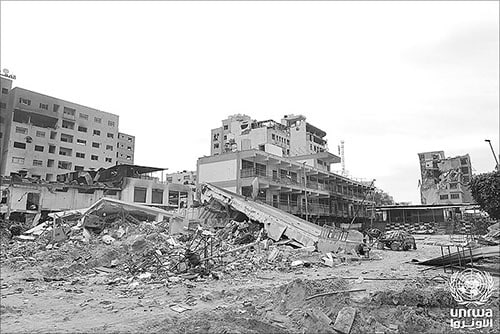
I imagine my son waiting for the bus each morning, the bus that no longer exists, to take him to the kindergarten that no longer stands, but was once filled with the sounds of children. I wonder what that kindergarten imagined for itself just before it was bombed, the desks and shelves and toys rising upwards, defying that same gravity written in its books.
Yamen is nearly six years old now. He asks me why I won’t register him for school. He says, “I want to have education so I can be old like you, Mama and Baba. I want to get up early, brush my teeth, drink milk and wash my face to be ready to learn.” I reassure him daily that, Inshallah, “Soon” he can earn a certificate. This word “soon” has become like a wave on the sea that keeps moving farther out, just like the ceasefire that never existed for us.
But my son has earned two certificates outside of school. The first is the Certificate of Suffering, which all Gazans now hold. The second is a Certificate of Waiting. Waiting for food, waiting to fill the water jug, waiting for a sky clear of bombers, waiting to wake alive one more day in this worn-out tent we share with mice and insects.
But like his mother, my son will continue to hope for education and life. Because he is Palestinian, and lives inside our beloved Gaza.
– Rawand
A few days after the recent U.S. midterm elections, I listened to senator-elect Abdul El-Sayed, who was asked by an interviewer what his views were on Israel, U.S. aid to Israel, and antisemitism.
El-Sayed criticized in no uncertain terms U.S. unconditional military aid to a nation built on “apartheid” (which it is) whose government’s treatment of Palestinians constitutes “genocide” (which it does). I have not encountered many U.S. politicians willing to speak so honestly about any of this.
He also made clear something that every apologist for Israel’s current policies completely ignores: that opposition to Israeli government policies does not equal a hatred of Jews living in Israel or anywhere else, including the U.S.. It is not antisemitic to deplore either apartheid or genocide.
He talked about the worries he has for his own children’s safety as Muslims in America, his belief that all children should be safe, and that all of us have a shared responsibility to combat both antisemitism and Islamophobia.
I have run out of patience with people who take any criticism of Israel as proof of antisemitism. Who argue that the deaths of some 78,000 Palestinians in Gaza and the West Bank since October 7th, 2023, by the Israeli Defense Forces and the so-called “settlers” are justifiable in the face of what Hamas did on that day.
Hamas did not even exist when the first Intifada began in 1987, and in fact was created with the help of the Israeli government in a successful attempt to prevent the Palestinian Authority (the descendant of the Palestine Liberation Organization) from taking control in Gaza.
Moreover, Israeli “settlers” in the West Bank have regularly and routinely engaged in terrorism, including murder, with impunity ever since 10/7/23, and even before that day.
So the argument that Hamas has brought this retribution upon the Palestinian people is simply without foundation.
Meanwhile, Rawand and her husband and her children have never done anything to anyone, and do not deserve what is happening to them every single day of their lives.
I hope with all my heart that some of these newly elected members of Congress like El-Sayed will have the courage and the influence to change U.S. policy in the Middle East. We can certainly expect nothing new from professional political hacks like Hakeem Jeffries and Chuck Schumer. But maybe, just maybe, this Big Blue Wave will result in real change, and Rawand and her family will live long enough to see an end to their suffering.
–=≈=–
W.D. Ehrhart is a retired Master Teacher of History & English, and author of a Vietnam War memoir trilogy published by McFarland.