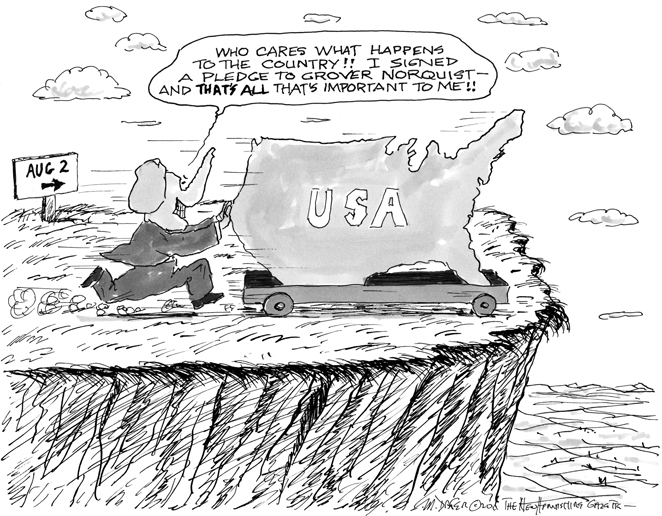
 The Fortnightly Rant for July 29, 2011, from The New Hampshire Gazette, Volume 255, No. 22, posted on Friday, August 12, 2011.
Online journalist Josh Marshall made a point Tuesday morning that is overlooked far too easily and too often:
“The centrality of debt holders in our constitutional order isn’t a bug, it’s a feature. Indeed, the national debt — created through the federal assumption of state war debts — was created to do precisely this: get the holders of bonds, necessarily wealthy and powerful people, to have a vested interest in the fixity and stability of the federal government.”
So, for all the good it will do us, we can blame these last seven months of tedious, repetitive, and unnecessary drama on that fornicating little foreign bastard Alexander Hamilton, who engineered this arrangement.
To reiterate briefly, the Federalists — who were the conservatives of their day — openly admitted that the only way this new nation could secure the allegiance of the wealthy was to buy it. Farmers and laborers, on the other hand, could be expected to fight and die in exchange for a little high-flown rhetoric.
Shameful as it was, or would have been if bondholders were capable of shame, this arrangement more or less worked until a black man got into the White House.
It’s Not About Race
We are not suggesting that Republicans are threatening to destroy the economy because President Obama is black; they’re doing it because he is not a Republican.
If Obama were a Republican,† they would raise the debt ceiling in the wee hours of a Saturday morning when no one was looking, same as always. The color of his skin just makes it easier and more satisfying for them to say, “No. Hell, no.”
Dysfunctional Family
It has become fashionable in some circles to equate the federal budget with the household income of a typical American family with 2.5 children and a dog, in a carrier, on the roof of a station wagon. If that analogy has any pertinence, here’s where we were in November of 2008, after the debt ceiling had been raised 28 times times during the five previous Republican administrations: the garage had burned down, the car was up on blocks in the front yard, the refrigerator was empty, the dog had wandered off in search of food, and all the change had been plucked from between the sofa cushions.
Not surprisingly, at that point the average schnooks of this country decided to pick a new leader from a different, less aristocratic branch of the family.
(Tea) Party! (Tea) Party!
For a couple of months, between the election and Obama’s inauguration, little green shoots of hope seemed to spring up everywhere, even in the dead of winter. Everybody was happy — except for the friends of Alexander Hamilton.
Less than a month after the inauguration a cable news shouter named Rick Santelli expressed outrage that some victims of predatory mortgage brokers might get a little help from the government. A disabled American, Santelli is irony-impaired: when he was a hedge fund trader, his secretary paid a far higher tax rate than he did. As a remedy for his own discomfort, he proposed a new Tea Party.
Fox News immediately began a promotional campaign for the Tea Party. If it had been paid advertising its would have cost billions. Through relentless repetition, Fox owner Rupert Murdoch got the Tea Party onto the news agendas of other networks — even ones with pretensions of seriousness. After all, the best advertising is the kind the other guy pays for.
The Koch brothers, and other lesser billionaires, happily invested untold mountains of money with various slithery Republican operatives who organized the inchoate Fox-oid masses with Gadsden flags to rally around.
The Tea Partiers were mad as hell, and for damned good reasons. Thanks to their investments in the political system, though, the friends of Alexander Hamilton had nothing to worry about.
Citizens Benighted
The Obama Administration began its first term with a budget already crippled by Bush tax cuts, unfunded wars, and even lower tax revenue from an economy ruined by the earlier shenanigans of an unregulated Wall Street.
For the first two years, the Republicans, their hold on government reduced to a tenuous beachhead in the Senate, made judicious use of the filibuster — which is to say, they employed it at every opportunity. That gave them something solid to run on when the 2010 mid-term elections rolled around: two years worth of Congressional gridlock.
Then the heirs of Hamilton, flush with money thanks to low capital gains taxes and able to spend it more freely than ever thanks to Citizens United — a little gift from their apolitical friends at the Supreme Court — filled the public airwaves with an unprecedented campaign of expensive anonymous commercials full of carefully crafted lies.
Money Back Guarantee
It took heroic sums of money to get Republicans elected in 2010, but that was to be expected; repairing a badly damaged political base is never cheap. Considering the extent of the Bush debacle, it was a miracle it could be done for any amount.
As with all investments, those who put up the money want to get it back — with interest. And this is the perfect time to do it. Convenient debt ceiling limits don’t come along every day.
Circumstances led to a somewhat shoddy class of Congressional candidates, so the process of wringing more out of those who have the least may be a little on the ragged side, but that can’t be helped. Sometimes you have to make do.
The important thing to remember is that when the retired middle school kitchen lady doesn’t get her Social Security check and the disabled vet can’t get his medication, we should all take it calmly.
It’s not personal. It’s strictly business.
The Alexander Hamilton line made me laugh, but you’re repeating an old shibboleth (is there any other kind?) here. Hamilton wanted all the states to assume the war debt collectively because it would make the country have a sense of itself as a nation, and also because some states were more in debt than others–notably, Massachusetts, which Hamilton applauded as “the fulcrum of the revolution” and whose draconian attempts to pay off its debts resulted in Shay’s Rebellion.
Hamilton did his best to get himself killed on the battlefield during the Revolution, and he was a leading opponent of slavery, so give him more credit. He even wrote to a friend, “I hate money-making men” and to another “I don’t want to be rich.” So unAmerican indeed–in a good way.